You're halfway through your backswing when your polo starts creeping up your torso. By the time you reach the ball, the hem has ridden clear of your waistband, and you're adjusting your shirt between every shot. This isn't a fit problem you're imagining, it's a real consequence of how fabric behaves during the rotational and lateral forces of the golf swing.
Golf polos ride up because of the interaction between fabric construction, the way garments are cut, and the specific demands of the golf motion. When you rotate your shoulders and shift your weight, the fabric stretches and moves in ways that everyday clothes rarely experience. This problem affects golfers at every skill level, from weekend players to low handicaps, and it compounds across a full round in summer heat, humidity, or layered winter conditions.[3]
Understanding why this happens, and what separates a polo that stays in place from one that doesn't, comes down to three key factors: the fiber blend and elasticity of the fabric itself, the fit category and proportions of the garment, and how you layer underneath. This article walks you through what to look for in each area so you can choose and wear polos that perform as well as they look. A polo that bunches and rides up mid-swing breaks your focus and exposes skin to sun and chafe for the remaining holes, Haven Golf Company's Airflex™ material moves with your torso through the full rotation, staying tucked and flat from address to follow-through.
TL;DR
Golf polos ride up due to loose fit, non-stretch fabrics, and the rotational motion of the golf swing pulling fabric upward and outward.
The combination of a relaxed cut and low-stretch materials means the fabric can't move with your body during the swing's extreme range of motion.
Choosing a fitted cut with stretch fabric helps keep your polo in place throughout a full round.[5]
Understanding Why Your Golf Polo Rides Up During Your Swing
What Causes Fabric Riding Up During a Golf Swing
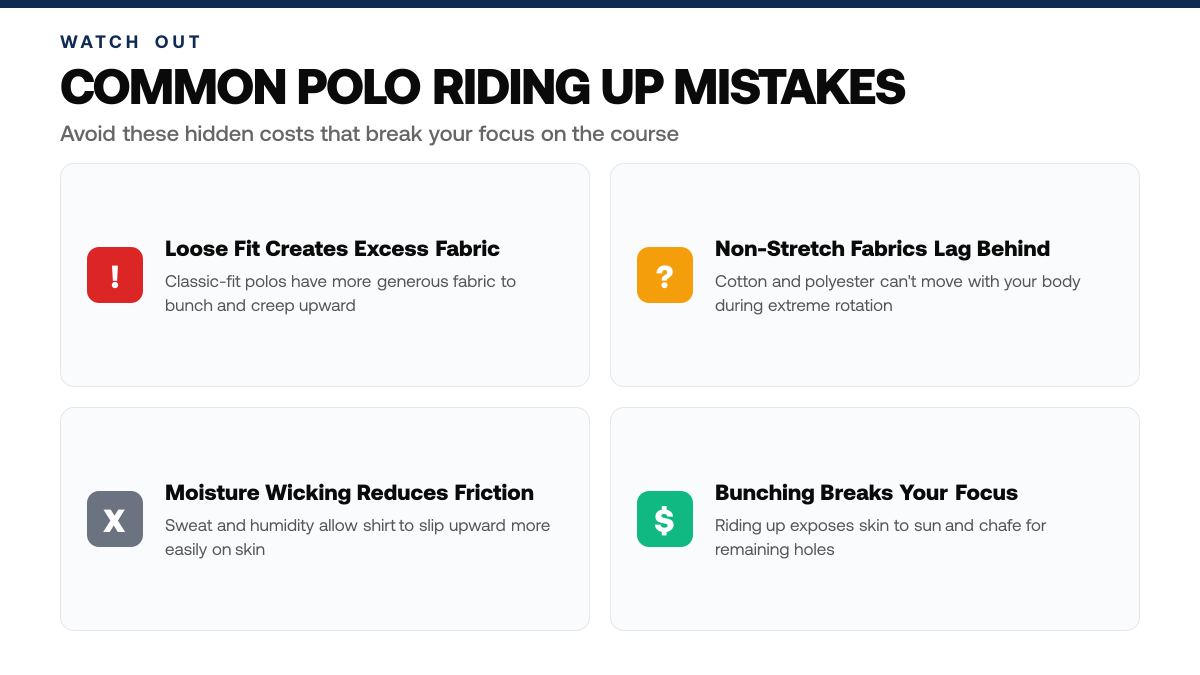
A golf swing creates biomechanical stress that pulls fabric in multiple directions simultaneously. During the backswing, your torso rotates more than 90 degrees, stretching the shirt across your shoulders and sides. The downswing then accelerates your arms and shoulders forward with significant force, creating lateral tension. The follow-through extends your spine and shifts your weight, pulling the hem upward. Cotton, polyester, and elastane-blend fabrics respond differently to these movements, some stretch and recover quickly, while others lag behind your body's motion, causing the shirt to bunch and ride up. Moisture-wicking synthetics add another variable: when sweat and humidity interact with the fabric, the material's grip on your skin changes, reducing friction and allowing the shirt to slip upward more easily.[4]
The physics of riding-up becomes even more pronounced when you consider the repetition across 18 holes. Each swing subjects your polo to the same upward pull, and with every swing, if the fabric lacks adequate stretch and recovery properties, it gets pulled slightly higher than the previous swing. Over the course of a round, this cumulative effect means a polo that barely rides up on hole one can be completely untucked by hole nine. Understanding this pattern helps explain why some golfers experience more dramatic riding-up than others, even in the same conditions.
How Fit Categories Affect Riding Up
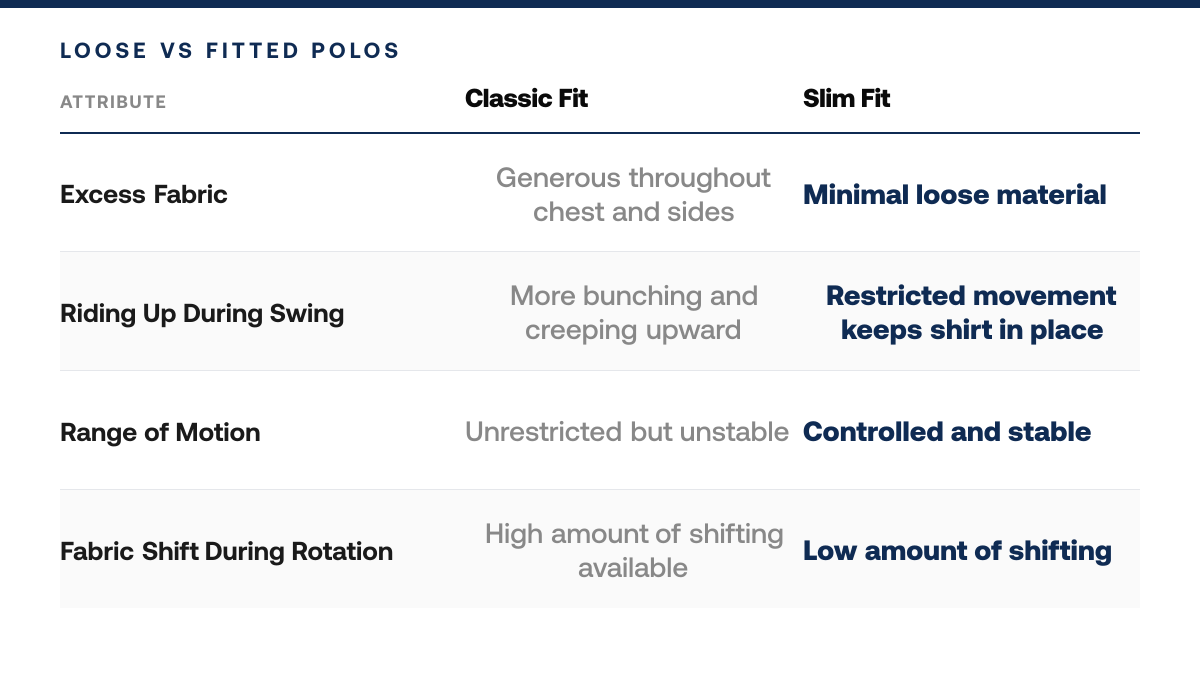
The amount of excess fabric in your polo determines how much room it has to ride up. Slim-fit polos hug your torso closely, leaving minimal loose fabric to shift during your swing. Modern-fit polos sit between slim and classic cuts, offering a balance of comfort and control, they keep the shirt close enough to your body that movement is restricted, but loose enough for a full range of motion. Classic-fit polos have more generous fabric throughout the chest, sides, and hem, which means more material available to bunch and creep upward as you rotate and extend. Choosing a fit that matches your body type and swing style reduces the likelihood of riding up, since less excess fabric exists to move independently of your torso.[4]
It's important to note that fit category varies significantly across brands. What one manufacturer calls a modern fit may sit differently than another brand's modern fit. When shopping online or trying polos in-store, always perform a practice swing or torso rotation to test how the fabric stays in place. This real-world test reveals whether a particular brand's cut will work for your body and your golf motion better than relying on size charts alone.
Fabric Composition and Performance in Heat and Humidity
Golfers who play regularly in real conditions, summer heat, morning humidity, and variable weather, face fabric behavior that changes throughout the round. Pure cotton absorbs moisture and becomes heavier, which can increase friction initially but also causes the fabric to sag and shift as sweat accumulates. Polyester and elastane blends stretch more uniformly and recover faster, keeping the shirt's shape stable during repetitive swings. Moisture-wicking synthetics are engineered to move sweat away from your skin, but this same property can reduce the grip between fabric and body, making the shirt more prone to sliding upward. Understanding how your polo's composition responds to heat, humidity, and perspiration helps you anticipate fit issues and select materials that perform consistently across a full round.
Temperature also plays an underrated role in fabric behavior. In cooler conditions, fabrics tend to be stiffer and hold their shape better. As temperatures rise and fabric warms, it becomes more supple and flexible, which can either improve movement or increase the likelihood of riding-up depending on the fiber blend. Testing your polo in the actual season and weather conditions you play in most often gives you the clearest picture of how it will perform on your regular courses.
Step-by-Step Process
1. Choose a fabric with elastane or spandex blend
Select a golf polo made from a fabric blend that includes at least 5% elastane or spandex. This stretch component allows the fabric to move with your body during your swing without permanently deforming or losing shape. Look at the fiber content label, quality performance polos list the elastane percentage prominently. Fabrics with adequate stretch recover to their original form after each swing, preventing the bunching and riding-up that occurs when fabric lacks recovery properties.[2]
2. Select a modern or slim fit category
Choose a polo in a modern or slim fit rather than a classic or relaxed cut. These tailored fits keep the fabric closer to your torso throughout your swing, reducing excess material that can bunch up or shift upward. This is where a brand like Haven Golf Company earns its keep. A fit that hugs your body without restricting movement anchors the polo in place, so it stays down as you rotate through your backswing and follow-through. Try on both fits side-by-side to feel how the tighter silhouette prevents migration.[2]
3. Verify sleeve and torso length are proportional
Measure that the sleeve length reaches your wrist bone when your arm hangs naturally, and the torso length hits at or just below your hip. Sleeves that are too long ride up your forearms during the swing, pulling the entire shirt upward. Quality-first makers like Haven Golf Company sweat this detail so you don't have to. A torso that extends too far past your hip creates excess fabric that bunches and migrates. Proper proportions ensure the polo stays in place across a full 18 holes, even in summer heat or humidity when fabric softens.
4. Layer with a fitted base layer for immediate improvement
If you already own polos that ride up, adding a fitted moisture-wicking base layer underneath creates friction between the layers. This friction acts like an anchor, gripping your polo and preventing it from sliding upward during your swing. The base layer itself should fit snugly to your skin without excess fabric. This solution works immediately and costs significantly less than replacing your entire polo wardrobe, making it an ideal short-term fix while you shop for better-performing polos.
How This Works in Practice
Example 1: The Weekend Player in a Classic Cotton Polo
Picture a golfer who reaches for a favorite classic-fit cotton polo, the kind with a loose, relaxed cut that feels comfortable in the clubhouse. The fabric is soft and breathable, which is appealing on a warm day. But as he moves through his first few holes, the polo begins to ride up noticeably with each swing. The loose fit offers no resistance when his torso rotates through the backswing; the non-stretch cotton fabric simply gets pulled upward and doesn't recover to its original position. By the turn, he's tugging the shirt down every few holes, distracted and uncomfortable. The problem compounds in humidity, the damp fabric clings differently and loses its shape even faster. What started as a comfortable choice becomes a frustrating distraction that lasts the entire round, pulling his focus away from his game.
Example 2: The Regular Player in Modern Synthetic Blend
Consider a golfer who wears a modern-fit polo made from a synthetic blend with elastane stretch. The fitted cut hugs the torso without restricting movement, and the fabric moves fluidly with each rotation of the shoulders and core. When he swings, the stretch fibers elongate with his body, and then recover back to their original position once the motion completes. Across 18 holes, through multiple rounds of swings, walking, bending, and turning, the polo stays tucked at the waist and maintains its shape. The fitted silhouette also means there's less excess fabric to ride up in the first place. Even in heat and humidity, the synthetic blend resists the sagging and shape-loss that cotton experiences. He finishes his round looking as polished as he did on the first tee, and he's never once adjusted his shirt during play.
Why Fit and Fabric Matter
Both golfers faced the same challenge, keeping their polo in place during a full round, but their outcomes diverged based on two factors: the cut of the shirt and the fabric's ability to move and recover. Loose fit plus non-stretch fabric creates the conditions for riding-up; fitted cut plus stretch fibers prevents it. Understanding this dynamic helps you choose apparel that performs across the entire round, not just in the pro shop.
Golf Polo Fit & Comfort Checklist
Check the fit model (modern or slim cut) against your typical shirt size to confirm the polo won't bunch or ride up during your swing.
Verify the fabric blend includes elastane or spandex for stretch and recovery during movement and heat exposure.
Measure sleeve length so it reaches your wrist bone without riding up when your arms are extended in your golf posture.
Confirm torso length covers at least to your hip or slightly below to prevent the polo from riding up at the waist during your swing.
Test the polo through at least one full swing or torso rotation before purchasing to confirm it stays in place during the motion.
Consider the climate and season you play most frequently, and select fabrics that have proven performance in those specific conditions.
Review customer feedback or try on multiple brands, as fit varies significantly even within the same size across different manufacturers.
Common Mistakes to Avoid
Mistake: Choosing a classic or oversized fit thinking it will feel more comfortable
Excess fabric has more room to migrate upward during your swing's rotational movement. The looser the garment, the more it can shift with each turn. Instead, prioritize a tailored fit that hugs your torso without restricting shoulder and arm movement, snug fabric stays put during the swing rather than bunching and riding up.[1]
Mistake: Buying 100% cotton or low-elastane polos without testing them through a full swing
Natural fibers and minimal stretch lack the recovery needed to return to their original position after rotational stress. When fabric doesn't bounce back, it stays displaced upward. Test any polo through a complete swing sequence, or choose blends with adequate elastane (typically 4–8%) that maintain shape and position through the full range of motion.[1]
Mistake: Ignoring torso length and buying polos that are too long
Excess length bunches at the waist and provides slack that the upward pull of your swing can easily exploit. Measure from your shoulder to your natural waist, then choose a polo that hits at or just below your hip bone. A properly proportioned length eliminates the fabric pool that rides up as your torso rotates.[1]
Mistake: Assuming all performance fabrics behave the same in different weather conditions
A synthetic blend that performs beautifully in spring temperatures may behave differently in summer humidity or winter cold. The same fabric composition can feel and move differently depending on temperature, moisture saturation, and how it interacts with your skin. When possible, test polos in the specific season and weather conditions where you play most often, rather than purchasing based on spring weather performance alone.
Frequently Asked Questions
Why do some polos ride up more than others?
Fit, fabric composition, and how well the polo is anchored at the waist all play a role. Polos with looser cuts or heavier, non-stretch fabrics tend to shift more during the swing. Modern fits that blend elastane with traditional materials and maintain proper length minimize riding-up, keeping the shirt in place through your full range of motion.
Can I fix a polo that rides up?
Yes, several solutions work immediately. Layering with a fitted base layer underneath creates friction that anchors your polo in place. Tucking more deliberately at the waist, especially into the front of your trousers, also helps. For lasting results, choose a different fit or fabric for your next purchase, prioritizing styles with elastane blends and proper length.
Should I size up or down to prevent riding up?
Sizing up typically makes riding-up worse, not better, because excess fabric has more room to shift. A true-to-size fit that sits snugly at the waist and chest works best. If your regular size feels tight through the shoulders, look for a cut specifically designed for athletic movement rather than moving up a size overall.
Golf Polos That Won't Bunch or Ride Up — You're three holes in, and your polo has already ridden up at the waist or bunched across the shoulders. It's a distraction that pulls focus from your swing and leaves…
How to Choose Golf Polos by Swing Type — A golfer steps up to the tee in a polo that pulls tight across the shoulders, restricting the backswing. Another swings freely in a shirt tailored for their build…