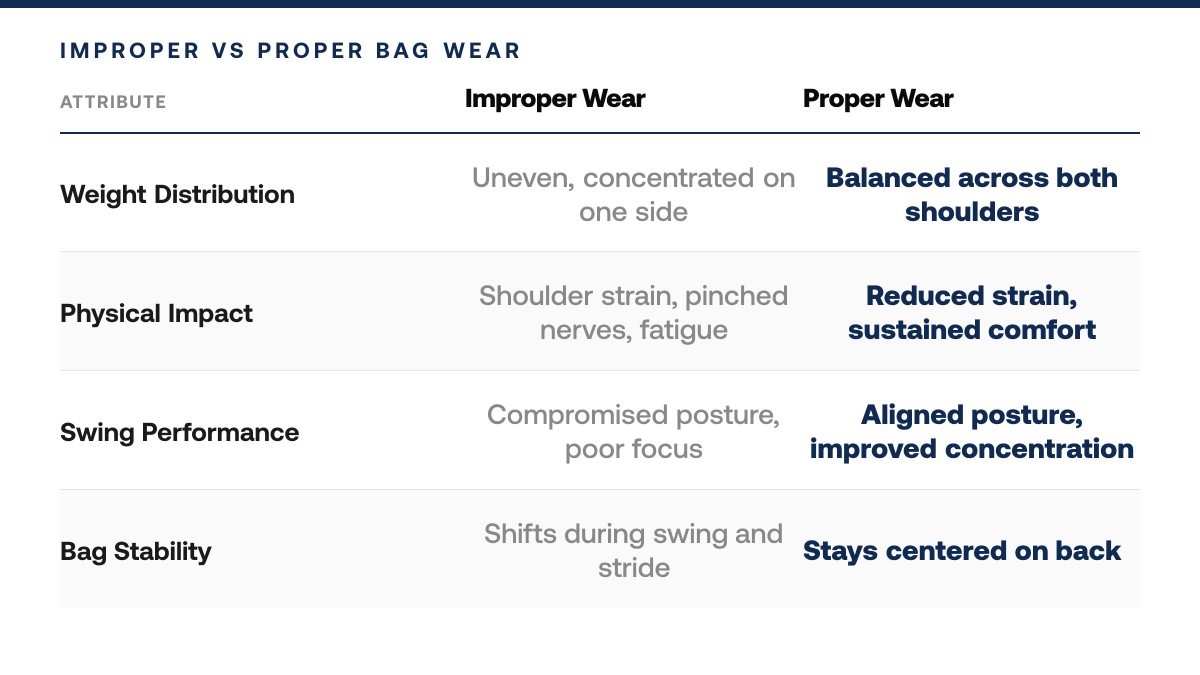
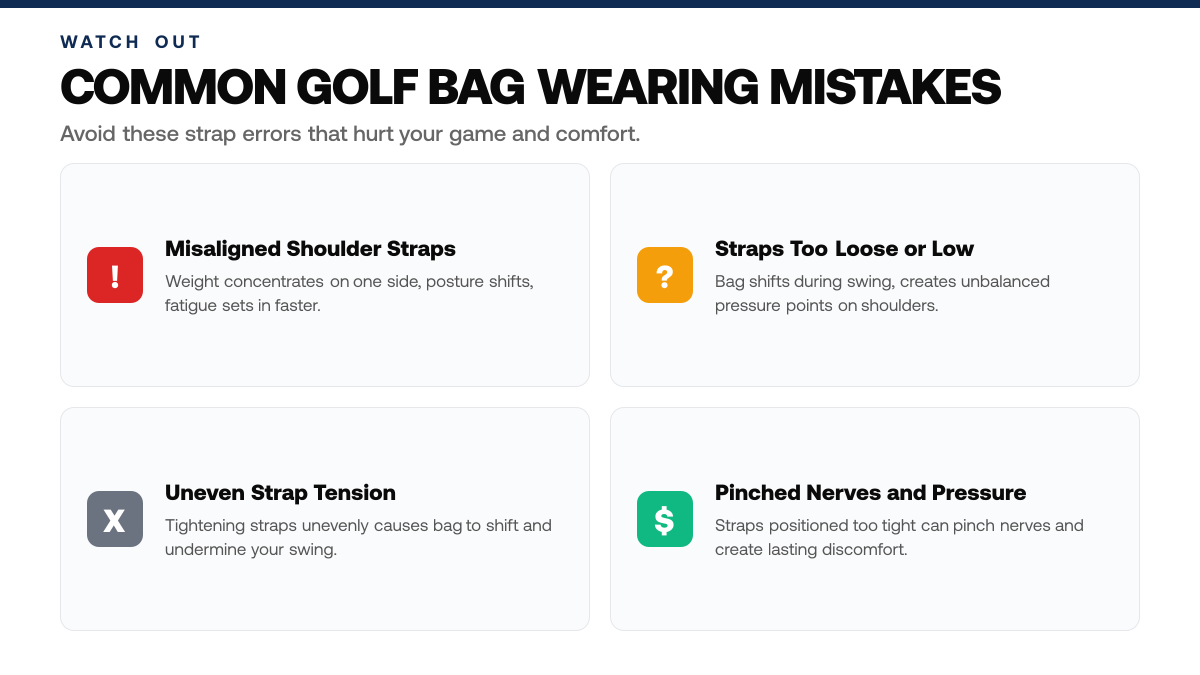
A golf bag that sits unevenly on your shoulders can turn a pleasant morning round into an uncomfortable slog by the back nine. When straps are misaligned or too loose, weight concentrates on one side, your posture shifts, and fatigue sets in faster than it should. The physical toll of an improperly worn bag isn't just discomfort, it can undermine your swing and pull your focus away from the game itself.
Golfers who play regularly in real conditions, summer heat and humidity, cold early-morning rounds, rain and wind, know that equipment comfort directly affects performance and enjoyment across 18 holes. Whether you're a weekend player, a low handicap competitor, or someone who travels to club and charity tournaments, how you wear your bag matters as much as which bag you choose. The market research in golf consistently shows that players prioritize gear that supports both their game and their physical well-being throughout a full round.[1]
This article walks you through the fundamentals of wearing a golf bag correctly: how to adjust both shoulder straps for even weight distribution, position the bag so it stays centered on your back, and secure chest and waist straps to prevent shifting during your swing and stride. You'll see how these principles apply in real conditions, summer heat, early-morning cold, and layered play, and learn a practical checklist to verify your strap fit before your next round. Common mistakes and their fixes will help you avoid the shoulder strain and fatigue that come from improper bag positioning.
Haven Golf Company sells performance golf and lifestyle apparel, primarily polos for men and women, crafted with their signature Airflex™ material for maximum comfort and durability.
TL;DR
Adjust straps so your golf bag sits centered on your back with even weight distribution across both shoulders for comfort during a full round.[1]
Proper strap positioning reduces shoulder strain and fatigue, allowing you to focus on your game rather than discomfort.[1]
Center the bag's load by tightening both shoulder straps evenly, uneven tension causes the bag to shift and creates unbalanced pressure points.[1]
Understanding How to Wear a Golf Bag: Carry & Strap Guide
What Is a Golf Bag Strap System?
A golf bag strap system is the set of shoulder straps, handles, and attachment points engineered into different bag styles to distribute weight and enable various carry methods during a round. Stand bags feature dual shoulder straps designed for carrying the bag on your back, cart bags include handles and sometimes single straps for placement in a golf cart, and tour bags, the largest professional-grade option, combine multiple strap configurations to support extended play and heavier loads. Each bag type's strap design reflects its intended use: stand bags prioritize comfort for walking 18 holes, cart bags optimize accessibility when stored in a motorized or push cart, and tour bags accommodate the demands of competitive play where durability and weight management matter equally. The positioning, width, and padding of these straps directly influence how weight transfers to your shoulders and back throughout a full round.
Why Proper Strap Positioning Matters for Your Game
Wearing your golf bag correctly prevents shoulder strain, uneven weight distribution, and fatigue that can compromise your swing and enjoyment across 18 holes. When straps sit too low or too tight, they can pinch nerves, create pressure points, and cause your shoulders to fatigue long before you finish the back nine. Proper strap positioning keeps the bag's weight centered on your shoulders rather than pulling to one side, which reduces muscular compensation and maintains your posture during the swing. Golfers who play regularly in real conditions, summer heat and humidity, cold early-morning rounds, rain and wind, benefit most from correct strap use because physical comfort directly affects concentration and performance. Weekend players through low handicaps who travel to club and charity tournaments rely on proper bag fit to stay comfortable during tournament rounds where mental sharpness and physical endurance are equally important. The difference between a well-fitted bag and a poorly worn one becomes most noticeable after 12 holes, when fatigue and discomfort can undermine your game.
Market Context: Bag Design and Golfer Needs
The golf equipment market reflects diverse player preferences and playing styles, with bag manufacturers designing distinct strap systems to match how golfers actually carry their clubs. According to the National Golf Foundation, market research in golf focuses on understanding how consumers think, feel and act, and bag comfort is a direct reflection of player priorities when choosing equipment for regular play. Golfers invest in bags that align with their playing habits, whether that means a lightweight stand bag for walking courses, a cart bag for resort play, or a tour bag for tournament competition. The emphasis on strap design and carry comfort across different bag categories shows that manufacturers recognize the physical demands of a full round and the importance of equipment that supports both performance and personal comfort. For golfers who play regularly and care about how they feel across a full round, selecting the right bag type and learning proper strap positioning is as essential as choosing the right clubs.[1]
Step-by-Step Process
1. Adjust both shoulder straps to equal length
Before putting on the bag, lay it flat and measure or visually compare the length of both shoulder straps. Loosen or tighten each strap so they are the same length. This ensures the bag will hang centered on your back and shoulders, preventing it from tilting to one side during your round. Uneven straps force one shoulder to carry more weight, which can cause fatigue and discomfort over 18 holes.
2. Position the bag so weight distributes evenly
Once the straps are equal, put on the bag and check how it sits on your shoulders. The bag should rest comfortably across both shoulders with weight balanced on each side. Shift the bag slightly if needed so it does not favor one shoulder or hip. Even weight distribution reduces strain on your back and neck, allowing you to focus on your swing and play rather than discomfort.
3. Secure chest and waist straps to stabilize the load
If your golf bag has a chest strap or waist strap, fasten it snugly but not so tight that it restricts your breathing or movement. These straps pull the bag closer to your body and prevent it from bouncing or shifting as you walk the course or swing. Stabilizing the bag reduces unnecessary movement that can throw off your balance and rhythm during play.
How This Works in Practice
Example 1: The Weekend Player in Summer Heat
Picture a golfer preparing for an afternoon round during hot, humid weather. Before heading to the course, she considers how her bag's strap positioning will affect comfort over eighteen holes. She checks whether the straps allow air to circulate against her back and shoulders, areas prone to sweat accumulation, rather than trapping moisture under tight, sealed contact. She thinks about how looser strap tension, when still secure enough to prevent shifting, can reduce the feeling of dampness and allow evaporation as she walks between shots. Her choice centers on balancing support with breathability: straps positioned to sit slightly away from her body rather than pressed flat, and adjusted to hold the bag firmly without compressing the fabric against her skin. This approach lets her monitor comfort throughout the round without needing to stop and readjust.
Example 2: The Early-Morning Player in Cool Conditions
Consider a golfer who regularly plays in early-morning or cold-weather rounds, often layering with jackets or sweaters beneath his polo. As he prepares to wear his bag, he recognizes that loose straps can allow the bag to shift as he moves through his swing and walks the course, especially when multiple layers add bulk and reduce his sense of the bag's position. He checks that his strap tension is snug enough to keep the bag stable against his layered torso, preventing the bag from sliding or rotating during his swing. He verifies that the straps sit securely over his shoulders and across his back, anchoring the load without gaps that could let it shift under the added volume of cold-weather clothing. His focus is on secure positioning that maintains consistency through his swing and gait, ensuring the bag stays where he expects it throughout the round.
Why Conditions Shape Strap Choices
Both golfers are making the same fundamental decision, how to wear their bag, but their priorities differ based on weather and layering. The summer player optimizes for airflow and moisture management, while the early-morning player prioritizes stability and secure contact. Understanding these trade-offs helps any golfer adjust strap positioning and tension to match the conditions of the day, ensuring the bag stays comfortable and secure across a full round.
Golf Bag Strap Fit & Comfort Checklist
Before your next round, inspect and adjust your golf bag straps to ensure comfort and performance across varying weather and course conditions. Proper strap fit prevents shoulder strain, bunching, and chafing during a full 18 holes, whether you're playing in summer heat, early-morning cold, or unpredictable rain and wind.
Check strap padding for compression or wear that could cause shoulder discomfort during a full round in heat or humidity.
Adjust strap length so the bag sits snug against your torso without bunching or shifting as you walk and swing across varying terrain.
Verify strap attachment points are secure and not frayed, especially before travel or tournament play.
Test strap comfort with your typical round apparel, layers in cold weather or lighter wear in summer, to confirm fit across seasons.
Inspect straps for moisture retention or mildew after rain rounds, and clean or dry as needed to maintain comfort and durability.
Common Mistakes to Avoid
Mistake: Ignoring strap length asymmetry during fitting
Uneven strap lengths force one shoulder to carry more weight than the other, creating asymmetrical load distribution that accelerates fatigue and discomfort across a full 18 holes. Before playing, adjust both straps to equal length so weight settles evenly across your shoulders and back. Check the fit while wearing the bag to ensure both straps sit at the same height and tension.
Mistake: Leaving straps loose or inadequately secured
Loose straps allow the bag to shift and swing during your stride and swing motion, throwing off your balance and posture mid-round. This instability forces your core and shoulders to compensate, leading to tension and poor form. Tighten straps snugly against your body so the bag stays stable and centered, moving as one unit with you rather than shifting with each step.
Mistake: Favoring one shoulder instead of distributing weight evenly
Habitually carrying the bag on a single shoulder concentrates all weight on one side, creating muscle imbalance and increasing injury risk over repeated rounds. Consciously shift the bag between shoulders or use both straps equally to share the load. Distributing weight across both shoulders reduces cumulative strain and helps you maintain consistent posture and swing mechanics throughout your round.
Frequently Asked Questions
How do I know if my golf bag straps are adjusted correctly?
Correctly adjusted straps should distribute the bag's weight evenly across both shoulders without digging in or sliding around during your swing. Start by loosening all straps, position the bag on your back, then tighten the shoulder straps so they sit comfortably without restricting arm movement. The bag should feel stable when you walk and rotate through your golf swing, with no pulling or pinching at the shoulders or sides. Proper strap tension varies based on your build, the bag's weight, and course terrain, what feels right on flat ground may need adjustment on hilly courses.
Why does my golf bag feel uncomfortable after nine holes?
Discomfort often develops from strap pressure building over time, especially on one shoulder if the bag has shifted during play. Course conditions, walking uphill, uneven terrain, or soft ground, can cause the bag to settle differently, changing how straps sit on your shoulders. Fatigue also makes minor irritation feel worse as the round progresses. Check that both straps are equally tightened, adjust them mid-round if needed, and ensure the bag's weight is centered on your back rather than pulling to one side. Padding in the strap area and proper carry technique help distribute pressure more evenly across a full round.
Should I carry my golf bag differently in hot weather versus cold?
Carry technique remains the same, but layering and strap placement matter more in temperature extremes. In summer heat and humidity, tighter straps can increase shoulder and back perspiration, so you may prefer slightly looser straps with breathable apparel underneath to reduce chafing. In cold early-morning rounds, layering under the straps can add bulk, requiring you to loosen straps slightly to avoid restriction. The key is maintaining even weight distribution and a stable bag position regardless of conditions. Adjusting straps before you start and checking fit after a few holes helps you adapt to how your clothing and body respond to the weather.
Complete Guide to Military Collection Golf Apparel — Walk into any golf shop and you'll spot them: polos in red, white, and blue with subtle military insignia, flag details, or patriotic color schemes. Golfers wearing…
Choosing Essential Golf Polos for Resort Wear & Travel — You're standing on the first tee at a resort course you've never played, the morning air already humid, and you realize your old cotton polo is already clinging to your…