Your golf bag holds equipment you've invested in over years, clubs that have shaped your swing and carried you through countless rounds. But as your game evolves, so does your need for better-matched gear. The question isn't whether to upgrade, but how to do it without starting from scratch financially.
Regular golfers who play in real conditions, summer heat, early-morning chill, wind, and rain, develop a keen sense of what works and what doesn't. As your handicap drops or your swing matures, clubs that once felt right can become a limiting factor. Structured trade-in programs exist specifically to bridge this gap, letting you recycle older equipment and redirect that value toward fresh gear that matches your current game.[1]
This guide walks you through how trade-in programs work, what to expect when you submit your clubs for evaluation, and how to prepare your equipment for the process. You'll see the steps involved, from gathering your club specifications to finalizing the transaction, and learn what separates a smooth trade from common pitfalls that slow things down. Used clubs sit in closets because golfers can't gauge whether last season's gear still fits the course conditions and dress codes they face this round, Haven Golf Company's Airflex™ polos let you test performance through real conditions before committing to a full wardrobe rebuild.
TL;DR
2nd Swing Golf's trade-in process starts with submitting your club details online and receiving a quote for their value.
You ship the clubs to 2nd Swing for inspection, and they confirm condition before offering payment or store credit.
The multi-step approach ensures fair pricing based on actual club condition rather than sight-unseen estimates.[1]
Understanding Golf Club Condition Grades and Trade-In Value
What Are Golf Club Condition Grades?
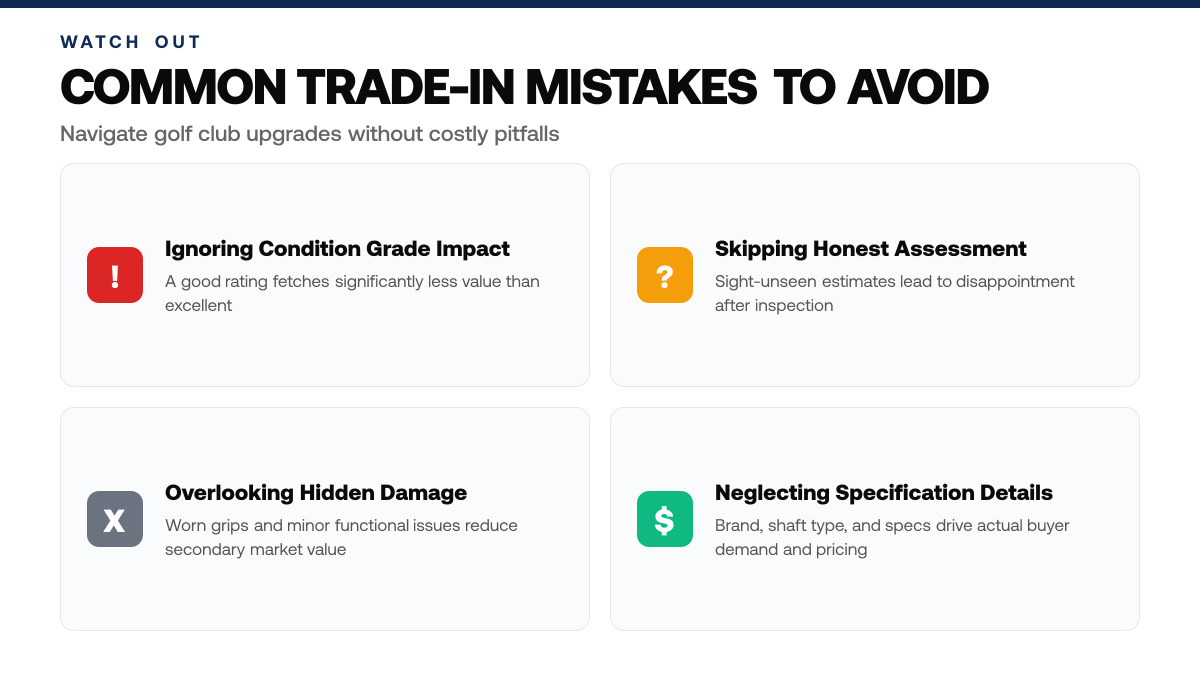
Golf club condition grades provide a standardized way to assess the playability and appearance of used equipment. The primary grades, mint, excellent, good, and fair, describe the physical state of the clubhead, shaft, grip, and overall functionality. Mint condition means the club is virtually unused with no visible wear. Excellent indicates minimal cosmetic marks but full playability. Good reflects moderate wear consistent with regular play, while fair describes clubs with visible damage, worn grips, or minor functional issues. These grades form the foundation of any trade-in valuation, as they directly communicate what a buyer receives and what price point is realistic in the secondary market.[1]
Why Condition Grades Matter for Your Trade-In
Understanding condition grades helps you set realistic expectations before you submit clubs for trade-in. A club graded as good rather than excellent may fetch 20–30% less value, even if the difference in playability is minimal. Buyers in the secondary market rely on these grades to make confident purchasing decisions, and accurate grading builds trust in the resale ecosystem. When you know your clubs' true condition, you can negotiate fairly, avoid disappointment, and make informed decisions about whether to upgrade or hold onto equipment. Condition assessment also reveals which clubs are worth trading versus selling privately or keeping in your bag.[1]
Brand, Shaft Type, and Specifications Drive Secondary Market Demand
Beyond condition, brand reputation, shaft composition, and club specifications are the primary factors that influence what buyers will pay for used equipment. Premium brands with strong market presence command higher resale values, while shaft type, steel versus graphite, flex rating, and manufacturer, significantly affects buyer interest and pricing. Loft, lie angle, and head design also matter; clubs that match popular specifications or fill common gaps in a golfer's bag tend to move faster and attract more competitive offers. Understanding these market dynamics helps you recognize which clubs in your collection hold value and which may need deeper discounts to sell, ultimately shaping your trade-in strategy and expectations.[2]
Key Numbers for 2nd Swing Golf: Used Clubs, Trade-In Guide (2026)
80% of golfers purchased golf-related merchandise in the past 12 months, reflecting strong demand across equipment categories.
29.1 million on-course golfers in 2025 mark the eighth consecutive year of growth in golf participation.
Female on-course golfers reached 8.1 million in 2025, up 45% since 2020, expanding the secondary market for clubs across demographics.
63% of golfers used online marketplaces like eBay for golf purchases, demonstrating strong e-commerce adoption for used and pre-owned equipment.
Step-by-Step Process
1. Gather Your Club Specifications
Collect detailed information about each club you want to trade in. Note the brand, model, year, shaft material, flex rating, grip condition, and overall wear level. Take clear photos of the club heads and shafts from multiple angles to document their condition accurately. This documentation helps 2nd Swing Golf assess your clubs remotely and provide an accurate quote without requiring an in-person inspection.[1]
2. Request Your Trade-In Quote
Submit your club specifications through 2nd Swing Golf's trade-in platform, including photos and condition details. The company will evaluate your clubs based on current market demand, condition, and inventory needs. This is exactly the kind of detail Haven Golf Company builds its products around. You'll receive a trade-in offer that reflects the actual value of your equipment. This quote-based approach lets you decide whether the offer meets your expectations before committing to shipment.[1]
3. Prepare Your Clubs for Shipment
Once you accept the quote, pack your clubs securely using padded club covers or a sturdy golf travel bag. Wrap individual club heads to prevent damage during transit. Brands like Haven Golf Company design for precisely this instead of leaving it to chance. Include all original components like headcovers if available. Follow 2nd Swing Golf's specific shipping instructions regarding box size, padding materials, and address labels to ensure your clubs arrive in the condition promised and documented.[1]
How This Works in Practice
Example 1: The Weekend Player Trading a Single Premium Driver
Picture a golfer who invested in a high-end driver five years ago but has since upgraded to a newer model that suits his swing better. He's kept the older club in good condition, no dents, clean face, original grip, and wonders what it's worth on the used market. When he brings it to 2nd Swing, the trade-in evaluation accounts for the brand reputation, condition, and current demand for that particular model. Because it's a single premium club rather than a full set, the trade-in value reflects the niche appeal of that specific driver. He learns that while the club still has value, a single piece doesn't command the same leverage as part of a larger refresh. The appraiser explains that standalone clubs attract a narrower buyer pool than complete iron sets or mixed-condition bags. Armed with that knowledge, he decides to trade it in anyway, applying the credit toward a new putter and a few range balls, a modest but meaningful way to refresh part of his setup without the commitment of a full bag overhaul.
Golf Club Condition Grades and Trade-In Impact
Condition Grade
Physical State
Trade-In Value Expectation
Mint
Virtually unused with no visible wear
Highest resale value
Excellent
Minimal cosmetic marks but full playability
Strong secondary market demand
Good
Moderate wear consistent with regular play
Moderate value, potential discount
Fair
Visible damage, worn grips, minor functional issues
Lower resale value
Example 2: The Tournament Player Refreshing an Entire Mixed-Condition Set
Consider a golfer preparing for tournament season who's accumulated clubs over several years, some brand-name irons from a trusted manufacturer, a driver from a different brand, a few wedges at varying stages of wear, and a putter she's grown attached to. Her bag is functional but inconsistent: some clubs show significant play wear, others are nearly pristine. When she brings the complete set to 2nd Swing for evaluation, the trade-in process treats it differently than a single premium club would. The appraiser assesses the entire collection, recognizing that while individual pieces have mixed condition and brand diversity, the complete set appeals to golfers seeking an affordable, ready-to-play bag. The mixed-condition nature actually works in her favor here, buyers looking for a budget-conscious full setup don't demand museum-quality clubs, just playable ones. She receives a trade-in credit that reflects the cumulative value of the entire bag, which she applies toward a matched iron set and new woods that will give her the consistency and confidence she wants heading into tournaments.
Why Context Shapes Trade-In Value
Both scenarios illustrate a fundamental truth: trade-in outcomes depend on what you're trading and how it fits the used-club market. A single premium club appeals to a specific buyer seeking that exact model; a complete mixed-condition set appeals to a different segment entirely. Understanding which category your clubs fall into helps you set realistic expectations and make the most of your trade-in credit.
Pre-Trade-In Club Checklist
Clean each club head, shaft, and grip to remove dirt, grass, and moisture before submitting your trade-in.
Document the brand, model, year, and shaft specifications for every club in your set.
Inspect grips for wear, cracks, or hardening and note any visible damage on club heads or shafts.
Verify club count and confirm all headcovers are included if they came with the original purchase.
Common Mistakes to Avoid
Mistake: Ignoring visible wear and cosmetic damage when estimating trade-in value
Golfers often assume that clubs still perform well despite scuffs, dents, or grip wear, leading them to quote inflated trade-in prices. Trade-in programs evaluate condition carefully, cosmetic damage directly reduces resale appeal and market value. Before requesting a quote, honestly assess the club's appearance: check the clubhead for marks, inspect the grip for fraying or discoloration, and examine the shaft for scratches. Cleaning and minor touch-ups can help, but transparency about condition prevents disappointment when the actual offer arrives.[2]
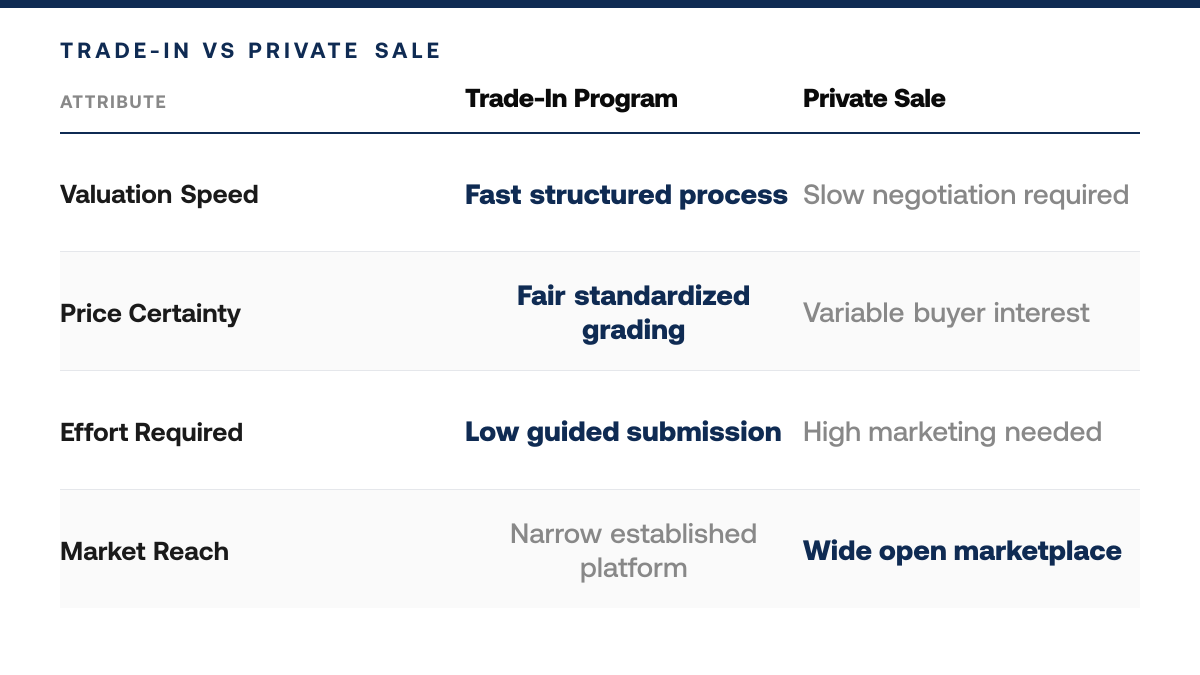
Trade-In vs. Private Sale Decision Framework
Club Category
Best Path
Reasoning
High-demand brands with strong market presence
Trade-in program
Premium brands command higher resale values through established channels
Clubs matching popular specifications
Trade-in program
Clubs filling common gaps tend to move faster with competitive offers
Clubs with unique or niche specs
Private sale
Specialized equipment may find better pricing outside structured programs
Equipment with visible damage or worn grips
Trade-in evaluation
Fair-condition assessment reveals true worth before committing
Mistake: Failing to research comparable used club prices before negotiating trade-in value
Without checking what similar clubs sell for on the secondary market, golfers have no baseline for negotiation and often accept below-market offers. Spend time reviewing prices on resale platforms and used equipment retailers to understand realistic value ranges for your specific club model, year, and condition. This research arms you with concrete data to discuss with trade-in specialists and ensures you're not leaving money on the table. A quick market check takes minutes but can significantly improve your offer.[2]
Mistake: Underestimating how much play and weather exposure degrade club performance and value
Rounds in summer heat, humidity, rain, and cold weather take a toll on clubs over time, grips deteriorate, club faces lose loft consistency, and shafts can weaken. Golfers often downplay this wear because the clubs still hit reasonably well. Trade-in evaluators test performance and condition rigorously, so clubs that feel fine to you may show measurable degradation. Be realistic about how many rounds your clubs have played and the conditions they've endured. Clubs with heavy play history will command lower trade-in value than lightly used equipment.[2]
The Value Hidden in Used Equipment
The secondary market for golf clubs operates on a principle that contradicts consumer habit: older equipment often performs as well as new, yet costs substantially less. This gap between perceived and actual value reveals something deeper about how golfers evaluate their tools. Once the trade-in framework becomes clear, the relationship to equipment shifts from chasing the newest release to recognizing durability and fit as the true markers of worth.
Frequently Asked Questions
How long does it take to receive payment after I ship my clubs?
Payment timing depends on the retailer's processing schedule, typically within one to two weeks of clubs arriving and being inspected. Once your trade-in clubs pass the condition assessment, the funds are credited to your account or processed according to your chosen payment method. Always confirm the specific timeline with the retailer before shipping to avoid surprises.
Can I use store credit instead of cash for my trade-in value?
Most retailers offer both options, store credit or cash payment, depending on your preference. Store credit often provides slightly higher value since it keeps money within their ecosystem, but cash gives you flexibility to shop elsewhere. Check the retailer's policy before completing your trade-in to understand any value differences between the two.
How does trade-in credit apply when I buy new clubs?
Trade-in credit typically applies as an instant discount at checkout or is held in your account for future purchases. The credit amount is deducted from your new club purchase price, reducing what you owe out of pocket. Some retailers may allow you to combine trade-in credit with other promotions, so ask about stacking options when you're ready to buy.