Old Money Golf Outfit: How to Dress Like a Club Pro
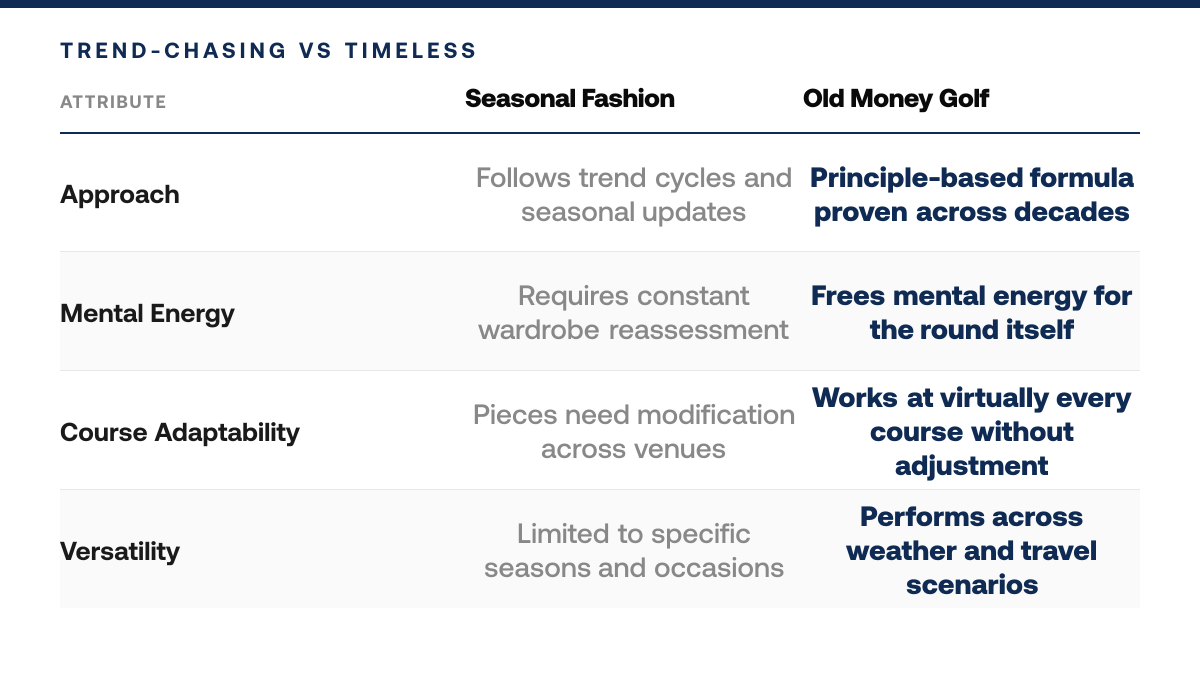
Walk into any private club on a Saturday morning and you'll spot the same silhouettes: V-collar polos in cream and navy, tailored linen trousers in light neutral tones, minimal accessories that signal quiet confidence rather than trend-chasing. These golfers aren't following seasonal fashion cycles, they're wearing a formula that has worked across decades and weather conditions. Old money golf style isn't about costume or historical recreation; it's a principle-based approach to dressing that prioritizes refined elegance, functional durability, and the kind of polish that works at virtually every course without adjustment.
Golfers who play regularly, across different club environments, in variable weather, and through charity tournaments, face a practical challenge: finding apparel that performs while reflecting personal identity and respecting course etiquette. The heritage golf formula addresses this by combining understated aesthetics with proven durability. A cream knit crewneck or neutral polo meets nearly every private club dress code without modification, freeing mental energy for the round itself. For players who travel to tournaments or care about how they look and feel across eighteen holes, this timeless framework ensures confidence and consistency.[5]
This article breaks down how to build an old money golf outfit step by step: starting with a quality V-collar polo in a neutral shade, layering tailored trousers and performance mid-layers for temperature changes, and finishing with minimal classic accessories. You'll see how this approach works in practice through two worked examples, one for the weekend player building a versatile foundation, another for the woman golfer embracing vintage precision without costume. A checklist and common mistakes section help you verify that your pieces align with your club's actual dress code and your real play conditions.
Haven Golf Company sells performance golf and lifestyle apparel, primarily polos for men and women, crafted with their signature Airflex™ material for maximum comfort and durability.
TL;DR
An old money golf outfit centers on a V-collar polo shirt paired with linen trousers for a timeless, understated look on the course.[4]
Accessorize with suede loafers and a classic watch to complete the refined aesthetic while maintaining comfort and performance.[4]
The palette stays neutral and crisp, think blue polos with white trim and light beige or white linen, for versatility across multiple rounds.[4]
Understanding Old Money Golf Style
What Is Old Money Golf Style?
Old money golf style prioritizes principles over specific pieces, clean silhouettes, heritage color palettes, and refined proportions that adapt across body types and climates. Rather than chasing trends, this approach focuses on timeless construction and understated elegance. The foundation rests on a proven formula: cream, camel, and navy knits that meet private club dress codes without modification and have remained relevant for decades. This principle-based method allows golfers to build versatile wardrobes where pieces work together regardless of weather, course location, or personal fit preferences.[2][5]
Why Old Money Golf Dressing Matters
Golfers who play regularly across different conditions and courses need apparel that performs while reflecting personal identity and club etiquette. Old money golf style addresses this by combining refined aesthetics with practical durability. The heritage approach eliminates decision fatigue, a cream knit crewneck or neutral polo works at virtually every private club without adjustment, freeing mental energy for the round itself. For players who travel to tournaments, join charity events, or care about how they look and feel across eighteen holes, this timeless framework ensures confidence and consistency without requiring constant wardrobe updates.[5]
The Evolution of Vintage Golf Dressing
Modern old money golf style draws from 1950s country club traditions, when women's golf dressing borrowed precision from menswear, including neckties and structured silhouettes. That era established a vocabulary of elegance, pointelle knits, clean lines, and neutral tones, that transcended gender and has endured because it works. The vintage foundation wasn't about costume; it was about intentional construction and heritage color choices that photograph well, move comfortably, and signal respect for the game and the course. Understanding this history helps golfers distinguish authentic vintage inspiration from themed or costume-like choices.[2][5]
Key Numbers for Old Money Golf Outfit: How to Dress Like a Club Pro (2026)
4.7-star average rating on golf apparel quality and durability reflects customer satisfaction with timeless, performance-focused pieces.[1]
Free shipping threshold of $199+ encourages investment in foundational, multi-season wardrobe pieces rather than seasonal rotation.[1]
Capsule collection approach organizes core layering pieces, waterproofs, mid-layers, base layers, polos, for efficient seasonal mixing.[1]
Country club aesthetic emphasizes classic golf attire and timeless silhouettes over trend-driven seasonal fashion cycles.[6]
Step-by-Step Process
1. Start with a quality V-collar polo in a neutral shade
Choose a V-collar polo shirt as your foundation, the defining piece of old money golf style. Select a neutral or heritage color such as blue, cream, or navy. The V-collar silhouette creates a refined, understated look that has remained a country club standard for decades. Pair it with crisp white details at the collar and sleeve edges to reinforce classic elegance. Ensure the fabric composition balances durability with comfort; a 50/50 cotton-polyester blend offers both structure and breathability for a full round in variable conditions.[4][5]
2. Layer tailored trousers in light, neutral tones
Pair your polo with tailored linen or cotton trousers in cream, white, or light beige. Linen trousers with a clean, straight cut maintain the refined silhouette while adapting to warm weather and humidity. The light neutral palette complements the V-collar polo and reinforces the understated elegance that defines the old money aesthetic. Ensure the fit is tailored, not oversized or overly slim, to project confidence and attention to detail across eighteen holes.[4][5]
3. Add performance mid-layers for temperature changes
Layer with performance-appropriate mid-layers such as knit crewnecks or mesh polos to adapt to early-morning chill, afternoon heat, and unpredictable weather. A cream knit crewneck or mint-gray mesh polo meets nearly every private club dress code without adjustment and has remained a reliable formula for sixty years. These mid-layers maintain the refined silhouette while providing functional warmth and breathability, allowing you to stay comfortable without compromising style across changing conditions.[5]
4. Complete the look with minimal, classic accessories
Finish with understated accessories that reinforce old money elegance: a simple round-dial watch with a leather strap, suede loafers in beige, and vintage-style sunglasses with UV400 protection. These minimal, classic pieces avoid over-accessorizing, which can read as costume-like rather than authentic, and instead project quiet confidence. Each accessory serves both form and function, protecting you from sun exposure while maintaining the refined aesthetic that defines a club pro's wardrobe.[4][5]
How This Works in Practice
Example 1: The Weekend Player Building a Versatile Foundation
Picture a golfer who plays regularly across multiple club environments, some with strict heritage dress codes, others more relaxed, and wants pieces that work in both settings without constant wardrobe swaps. He starts by considering the foundational formula: a cream knit crewneck or mint gray mesh polo paired with tailored trousers in navy or camel. According to heritage golf guidance, this combination "meets nearly every private club dress code without a single adjustment, which is exactly why it's held up for sixty years." Before committing to a full wardrobe rebuild, he would check his home club's specific dress code, verify the fit and fabric weight for the seasons he plays most, and consider how these neutral pieces layer under windbreakers or sweaters during cooler rounds. He's not looking for a guaranteed result, he's verifying that the formula aligns with his actual club environment and his personal comfort preferences for the conditions he faces.[5]
Example 2: The Woman Golfer Embracing Vintage Precision Without Costume
Imagine a woman golfer who admires the structured elegance of 1950s-60s country club style but worries that vintage-inspired pieces might read as costume rather than authentic course wear. She discovers that pointelle knit dresses, featuring "fine open-knit stitching that looks like tiny repeating flowers", appeared in that era "across American country clubs and European resorts" and remain a legitimate choice for modern play. She might also consider ribbon panel skirts and a structured necktie, understanding that "head golf's women's necktie in navy is the most authentically vintage accessory here, pulled directly from 1950s-60s country club wardrobes when women's golf dressing borrowed from menswear with real precision." Before assembling an outfit, she would verify her club's current dress code to ensure these pieces are accepted, check the fabric performance for her climate, and decide how many vintage elements to layer together, since "stack more than that and you start looking like you're dressed for a themed clubhouse party instead of eighteen holes."[5]
Why Heritage Formulas Endure
Both approaches, the classic Palmer-era neutral palette and the structured vintage silhouette, share a common principle: they prioritize authenticity over trend. A golfer's choice depends on verifying that the pieces align with their club's actual dress code, their personal identity, and the real conditions they face on the course. Heritage golf dressing works because it was built for function and acceptance, not novelty.[5]
Old Money Golf Outfit Checklist
Verify your club's dress code policy to confirm that neutral heritage colors and traditional silhouettes meet its specific requirements.[6]
Select base layers and mid-layer pieces designed for breathability and moisture management to perform across summer heat, humidity, and early-morning cold rounds.[1]
Choose waterproof or water-repellent outerwear and windbreakers rated for rain and wind protection during your regular play conditions.[1]
Ensure fit is tailored and proportionate, avoid oversized or trendy cuts that undermine clean lines and the refined aesthetic.[6]
Build a capsule of coordinating pieces (polos, pants, jackets, accessories) that work across multiple rounds and weather scenarios without requiring constant repacking.[1]
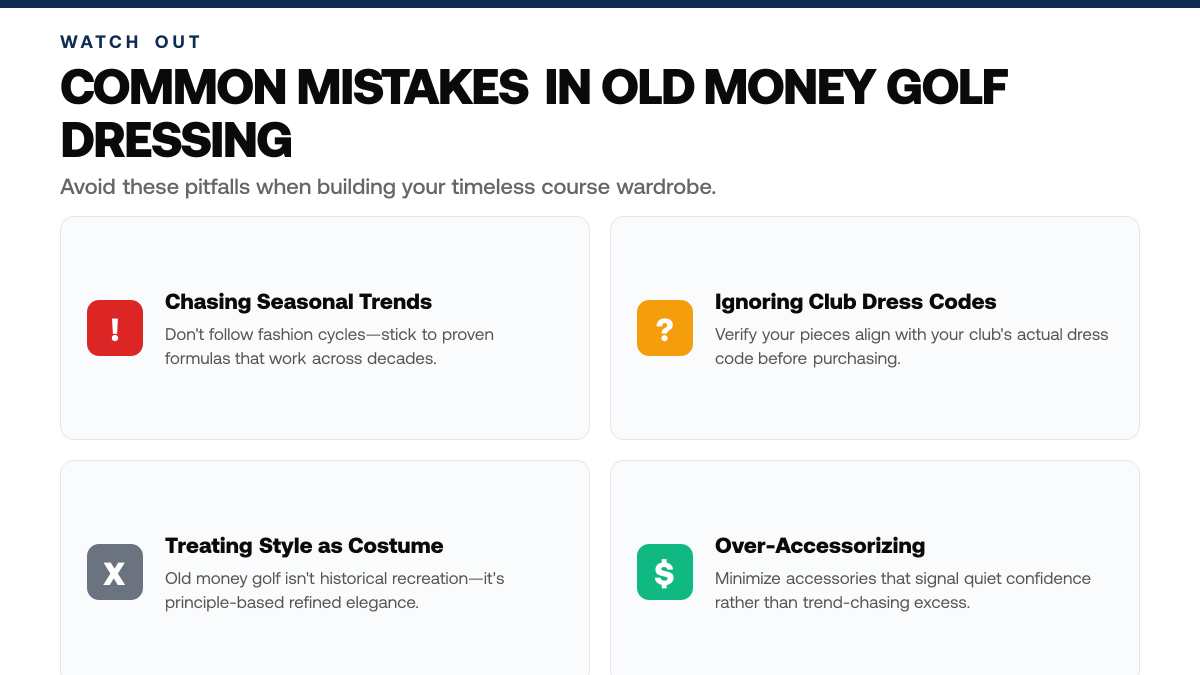
Common Mistakes to Avoid
Mistake: Treating vintage golf style as historical costume recreation
Wearing heavy tweeds, knickerbockers, and formal Victorian pieces as literal reproductions restricts movement, creates discomfort during a full round, and signals theme-party styling rather than refined elegance. Instead, focus on the principles behind old money golf, tailored fit, quality fabrics, and understated polish, using modern performance materials that honor the aesthetic without sacrificing playability or comfort in real course conditions.[2]
Mistake: Layering too many vintage-inspired pieces at once
Combining multiple heritage elements, oversized sweaters, patterned vests, heavy knit layers, and formal accessories simultaneously, creates a costume appearance that overwhelms the refined old money look. Build outfits with restraint: one statement vintage-inspired piece paired with clean, modern basics. This approach maintains elegance and allows freedom of movement across changing weather and the full 18 holes.[2]
Mistake: Ignoring modern fabric performance for historical authenticity
Choosing pieces based solely on how they looked decades ago ignores that today's golfers play in summer heat, humidity, rain, and wind. Moisture-wicking, breathable, and weather-resistant fabrics deliver the old money silhouette and refinement while keeping you comfortable and dry. Modern performance materials let you stay true to the aesthetic without the bulk, sweat, and restriction of genuine vintage construction.[2]
Frequently Asked Questions
How does clothing choice affect golf performance?
Clothing can make a significant difference in the performance of a golfer. The right apparel supports both comfort during play and confidence on the course. Weather-appropriate layering, quality construction, and refined proportions, principles that pro golfers follow, apply equally to weekend players and low handicaps. When you're protected from the elements and moving freely, you can focus on your swing rather than discomfort or distraction.[3]
What weather protection features should golf apparel include?
Golf apparel designed for real-world conditions should offer waterproof and windproof fabrics, breathability, and UV protection. Since golf originated in Scotland with unpredictable weather, modern golf clothing evolved to address rain, wind, cold, and sun exposure across a full round. Look for innovative materials that combine these protections without sacrificing comfort or mobility, so you can play confidently whether you're facing summer heat, early-morning chill, or unexpected rain.[3]
Why did pro golfer fashion change so dramatically in the 1950s?
Arnold Palmer became a golfing fashion icon in the 1950s by wearing tennis shirts and pants in bright colours on the course, a departure from traditional golf attire. He was the first to demonstrate how to dress like a pro golfer in a modern, expressive way. Palmer's influence opened the door to fashionable golf apparel that balanced performance, personal style, and refined appearance, setting the standard that golfers still follow today.[3]
How to Rock Old Money Golf Aesthetic in Timeless Polos — Walk into any golf club on a Saturday morning and you'll notice a shift in how players dress. Gone are the loud logos and aggressive color blocking that dominated the…
What to Wear: Golf Etiquette Dress Code by Course Type — Walk onto any golf course and you'll notice something immediate: players dress differently than they might at a casual sports bar or weekend park. Collared shirts…